Testimonials Level IT automates overhead cranes using 5G
Level IT, located in the Liège Science Park, specializes in IT solutions for sustainability. For example, through the Schenkingsbeurs giving platform, Level IT connects charities to food-oriented businesses with surplus products, ensuring perfectly edible food is not wasted. Founded in 2000, Level IT retains the agility of a start-up, according to founder Olivier Hault. “When Digital Wallonia launched a 5G call for projects in 2023 under ‘Industry of the Future’, we saw an opportunity to explore how 5G could reduce latency in industrial applications.”
Mobile Bridge
Together with Orange Business and the Technifutur training center, Level IT submitted the ‘Mobile Bridge’ project. The goal: develop a demonstrator of an industrial overhead crane using 5G technology. The project was approved with financial support from the Wallonia Recovery Plan.
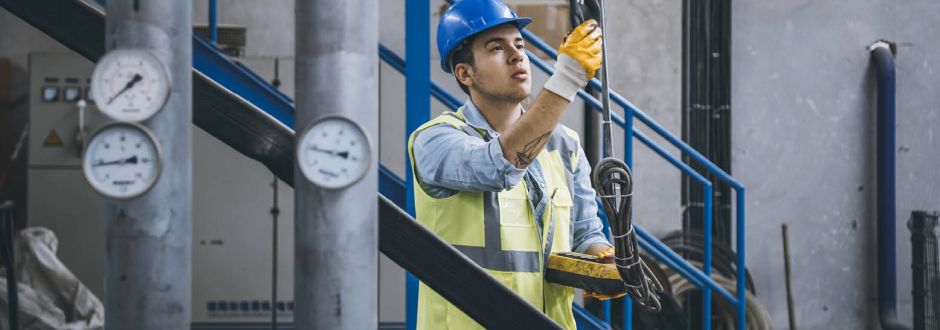
“An overhead crane moves along a rail above a workspace, for example in a warehouse,” explains Hault. “Such cranes are increasingly automated or centrally controlled. We wanted to create a proof of concept to showcase this to interested customers.”
Secure Access
The demonstrator is a fully functional 1/50-scale overhead crane, including a mobile app for Android tablets and iPads. Hault: “Operators can control the crane remotely and view camera images in real time.”
Using a “virtual private 5G network” keeps camera latency low. “Because it’s an industrial network, we have specific requirements,” Hault explains. “For security reasons, we did not want a connection via a public network, not even through a VPN. That’s why we chose a virtual private 5G network for the link between tablets and the crane.”
Low Latency
Another key factor for choosing 5G was minimalsignal delay. Hault: “An operator controlling the crane via tablet must see images in real time. Low latency is essential for reliable and safe crane operation.” To achieve optimal latency, Mobile Bridge uses a Multi-Access Edge Computing architecture. “Processing happens as locally as possible,” Hault adds. “The video server is near the crane, so images are available without delay.”
Applications Across Sectors
Hault calls the project a success in every way. “We now have a physical simulator to test real industrial configurations with their physical constraints. If a client requests crane automation, we can check if the required performance is feasible.” Technifutur also uses the setup as training material for the latest overhead crane technologies.
Level IT sees commercial potential for this PoC. “The technology allows a central team to operate or automate multiple cranes, which is valuable for many sectors, including food processing, chemical industry, logistics and more.”
Collaboration with Orange Business
Finally, Hault reflects on the partnership with Orange Business. “As a client, we never felt like just a number. On the contrary, we had a dedicated team. I can only praise the design, 5G infrastructure implementation and collaboration.”
Curious what 5G can do for industrial applications in your company? Contact us to explore the potential.